 Skip to main content

What is a Microscale Orifice Restrictor?
Published date: 20 Aug 2026
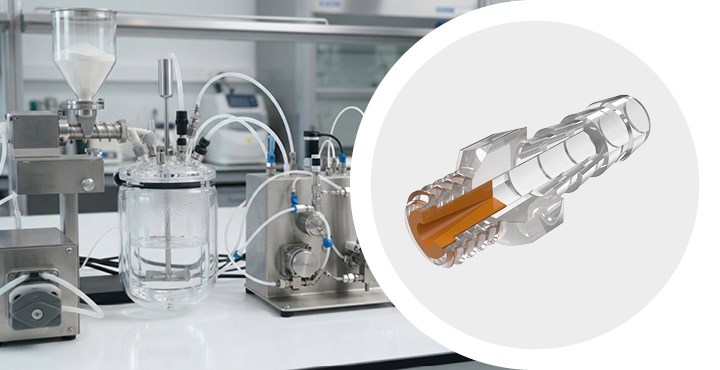
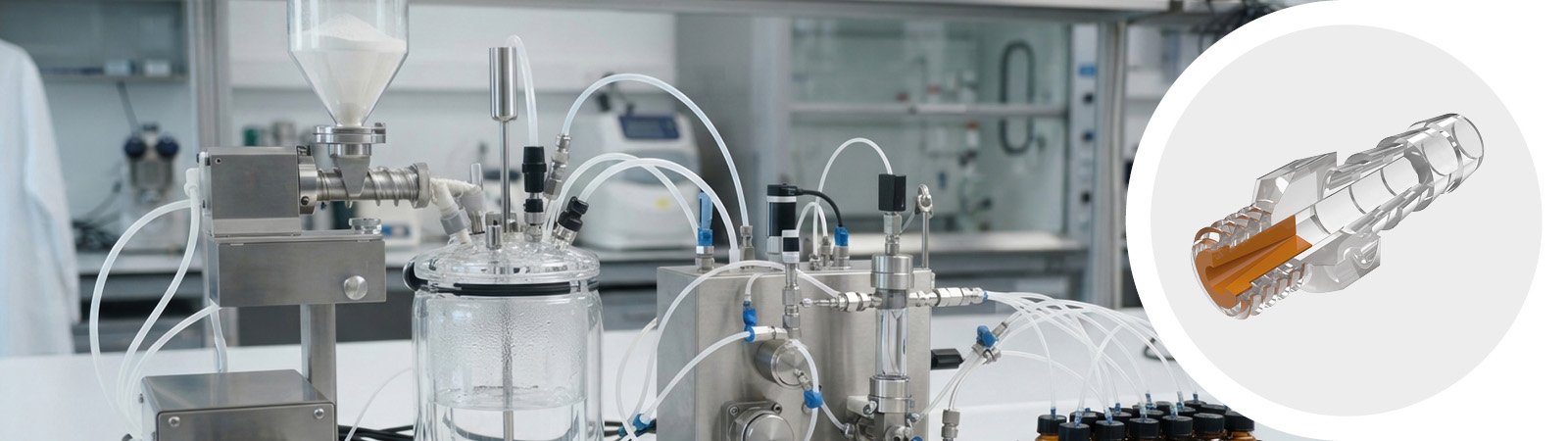
A common format is a small cylindrical body with barbed connections on either side (it can also come with luer, threaded, or push-fit connections if required). Inside that body is a precisely machined or moulded orifice: a very small hole that creates a deliberate restriction in the flow path.
The restriction creates back pressure upstream and a pressure drop across the orifice, this reduces the flow rate and stabilises downstream flow. They are used anywhere this functionality is desirable, with both liquids and gases, and commonly used in the medical, life science, process engineering, pneumatic and hydraulic industries.
Applications in Biotech
Possible uses:
- Control aeration rates in fermenters, or balance gas distribution between multiple culture vessels
- Control vacuum release rates in medical devices and reduce pressure fluctuations upstream of filters
- Create a controlled bleed or vent path – a passive safety feature
Another use case is with peristaltic pumps. They can struggle at low flow rates - flow pulses rather than being smooth, and control becomes inconsistent. Adding an orifice restrictor introduces controlled back pressure. This helps dampen pulsation and pressure spikes and improves flow stability. This makes them useful in:
- Cell culture, where stable and predictable flow is critical
- Chromatography
- Any other sensitive analytical instruments, to reduce flow disturbances and smooth flow
Fixed vs adjustable restriction
A key advantage of a fixed orifice restrictor over an adjustable restrictor, like a needle valve, is repeatability. Over time, a needle valve can shift position or be adjusted unintentionally, which introduces variability. However, adjustable restrictors are still useful during development. A common approach is to use a needle valve to find the required pressure drop, measure and define the restriction, then replace with a fixed restrictor for consistency.
Alternatively, you can simply test a range of orifice sizes and select what works best experimentally.
Material and connection choices
Common considerations include:
- Media compatibility (corrosiveness, solvent exposure)
- Risk of leachables/extractables
- Pressure requirements
- Operating temperature
- Tubing type and size
- Whether the system is single-use or reusable
- Ease of assembly
- Reliability of sealing under operational conditions
For bioprocessing applications, PEEK, PVDF, or stainless steel are usually preferred materials to avoid deformation or performance drift after sterilisation cycles. For connections, options include barbs, luer locks, threads, push-fit and compression.
Leave us your comment
You need to login to submit a comment. Please click here to log in or register.